ST3 Specialties
Vascular Surgery ST3 Interview Guide 2026
The 2026 interview format across both stations, self-assessment and evidence verification, key dates and how to prepare for each question type.
By the TheatrePass editorial team · updated 1 September 2026 · 7 min read
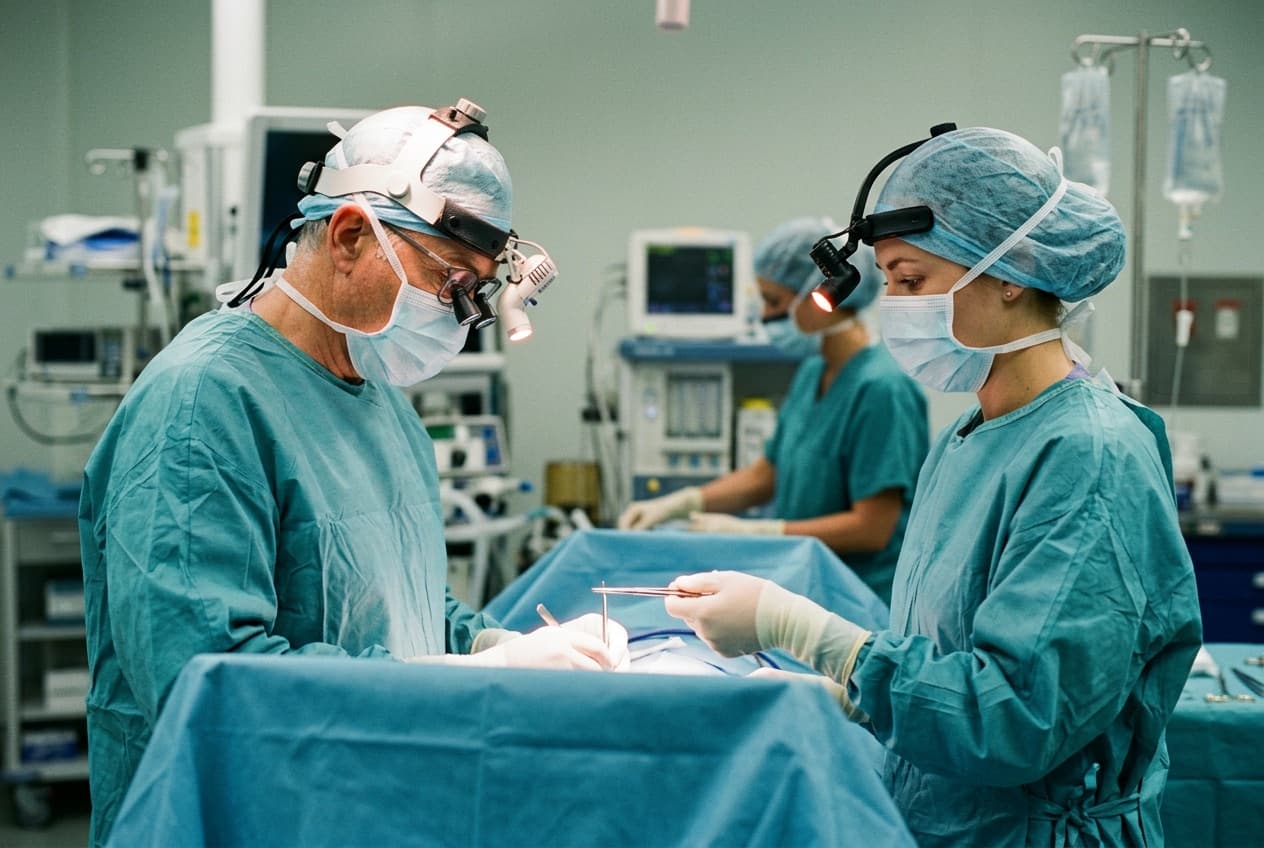
Vascular surgery selects for people who make safe decisions quickly, and its ST3 interview is built to test exactly that. The candidates you are ranked against have lived on the arterial take for years, the stations move fast, and hesitation reads as unreadiness in a specialty where minutes cost limbs. This guide covers the scenario types that recur in recent cycles, how to handle prioritisation across hospital sites, the decisive but safe phrasing that panels reward, and what the portfolio conversation expects of you at this level.
Interview format
NHS England publishes the vascular ST3 station breakdown in full on its open interviews page, which makes this one of the clearest formats in surgical selection. The interview lasts about 50 minutes, remotely, with two consultant interviewers live at each station and at most one silent observer. It runs as two stations of two questions each:
| Station | Question | Time |
|---|---|---|
| Station 1 | Clinical scenario (with 5 minutes of reading first) | 10 min |
| Station 1 | Communication scenario | 10 min |
| Station 2 | Management scenario (with 5 minutes of reading first) | 10 min |
| Station 2 | Virtual operative skills | 10 min |
The virtual skills question is the format's distinctive piece: ten minutes of questioning on operative knowledge and decision making, delivered online, so the marks come from talking through steps, instruments, hazards and decision points rather than doing anything with your hands. Practise narrating an operation you know well from skin to skin, because a clear spoken sequence is exactly what it rewards.
Key dates for 2026
| Stage | Date |
|---|---|
| Applications open | 10am, 20 November 2025 |
| Applications close | 4pm, 11 December 2025 |
| Evidence verification upload | 12 to 19 December 2025 |
| Interview (one day, remote) | Monday 9 February 2026 |
| Programme preferencing | 2 to 30 March 2026 |
| Initial offers | by 5pm, 14 April 2026 |
| Hold / upgrade deadlines | 22 and 23 April 2026 |
Two planning notes fall straight out of that table. The interview is a single day, 9 February, earlier than most ST3 interviews, so a preparation plan built for a late-March interview leaves you a month short. In the last published round (2025 round 2) there were 225 applications for 35 posts, a ratio of 6.43. The field is competitive but much smaller than the ST1 run-through specialties, and thorough preparation makes a real difference.
Common clinical scenarios
Vascular panels favour the handful of emergencies where the clock is the diagnosis. Two appear again and again in mock circuits and candidate debriefs.
The ruptured aneurysm call
An older patient, sudden abdominal or back pain, hypotension, perhaps a known aneurysm. The marks sit in recognition and parallel action: call the vascular consultant and anaesthetist immediately, secure large-bore access, activate the major haemorrhage pathway where appropriate, and resuscitate cautiously, accepting a lower blood pressure target under senior direction. Say explicitly that the decision between immediate theatre and CT angiography belongs to the consultant, and that your job is to make that decision possible fast.
The acutely ischaemic limb
A cold, painful, pulseless leg rewards a structured assessment spoken aloud: pain, pallor, pulselessness, paraesthesia, paralysis and a perishingly cold limb, with sensory and motor findings framed as the urgency markers they are. State the time of onset, consider embolic versus thrombotic sources, discuss anticoagulation as a decision you would make with the consultant, and name the threshold for theatre as a senior call you are escalating towards, not avoiding.
Prioritisation across sites
Vascular services in the UK are organised into networks, with arterial hubs taking referrals from surrounding hospitals. Panels use this: expect a scenario where two emergencies unfold in different places at once. The scoring pattern rewards candidates who triage by threat to life over threat to limb, use the whole team rather than their own legs, give clear phone advice to the referring site, arrange transfer where needed, and inform the consultant about both patients early. Never pretend you can be in two places. Saying aloud that you cannot, and showing what you would do about it, is the answer.
Safe, direct phrasing
The single biggest difference between a middling vascular answer and a strong one is the verb. Commit first, then qualify. Compare the two registers:
| Hesitant | Decisive and safe |
|---|---|
| It might be worth thinking about theatre at some point. | I would alert theatres now and ask the consultant to make the operate or image decision. |
| I could maybe give some fluids. | I would resuscitate cautiously, accepting a lower pressure target, guided by the consultant and anaesthetist. |
| We could probably scan them eventually. | If the patient is stable enough, I would request an immediate CT angiogram and call the vascular consultant before the scan, not after. |
Notice that the decisive column is not braver clinically. Every committed action is wrapped in senior involvement. Decisiveness in this interview means owning the next step out loud, not freelancing beyond your level.
Portfolio expectations at vascular ST3
The portfolio conversation expects evidence of trajectory, not just attendance. In recent cycles the recurring themes have been a consolidated logbook showing progression in open and endovascular exposure appropriate to your stage, at least one audit or quality improvement loop you led and closed, research output where you can defend the methods, and sustained commitment evidence: vascular rotations, relevant courses and specialty conference presentations. Indicative numbers vary, so check the current person specification rather than chasing a rumour. Prepare a one-line story for every item you have claimed, because the panel will pick two or three and probe.
How to prepare
- 1Weeks 8 to 6: map the emergenciesBuild one spoken framework that covers recognition, parallel resuscitation, escalation and the consultant-level decision. Apply it to the ruptured aneurysm, the ischaemic limb and the deteriorating bypass patient until the spine is automatic.
- 2Weeks 6 to 3: rehearse aloud, timedAnswer out loud every session, against the clock. Review recordings or transcripts for hesitant verbs, missing escalation statements and overruns, and fix one fault per week.
- 3Final fortnight: pressure and portfolioPractise with interruptions and cross-site prioritisation twists daily, and rehearse your portfolio one-liners aloud until each lands inside a breath.
Interview Library › Clinical scenario › Ruptured Abdominal Aortic Aneurysm
Clinical scenario
Ruptured Abdominal Aortic Aneurysm
A 74 year old man is brought to your emergency department having collapsed at home with sudden severe abdominal and back pain. He is pale and clammy, pulse 110, blood pressure 88/60. He is talking to you. He has a pulsatile abdominal mass and a history of a 6.2 cm aneurysm under surveillance, and the team have just returned from the CT…
Tell me how you would assess and manage this man from the moment he arrives.
“"This presentation is a ruptured abdominal aortic aneurysm until proven otherwise, and my job is to get him to aortic control without losing time on anything that does not change the decision. I would assess him along an ABC approach while making the calls that matter in parallel: my consultant, the anaesthetic team, theatres and the blood bank, activating the major haemorrhage protocol from the outset.”
“Access and bloods come with the assessment: two large bore cannulae, crossmatch, haemoglobin, lactate and a venous gas. Resuscitation is deliberately restrained. I would practise permissive hypotension, avoiding aggressive fluids, accepting a lower blood pressure as long as he stays conscious, commonly a systolic in the region of 70 to 90 mmHg, and using blood products rather than crystalloid when he does need…”
Why this scores
“my job is to get him to aortic control without losing time on anything that does not change the decision”
frames the whole answer around the time critical goal rather than a checklist.
“accepting a lower blood pressure as long as he stays conscious, commonly a systolic in the region of 70 to 90…”
states permissive hypotension precisely, with a physiological endpoint and a number.
References
Abdominal aortic aneurysm: diagnosis and management (NG156) National Institute for Health and Care Excellence
Clinical scenario · 22 scenarios
How TheatrePass helps
TheatrePass mock interviews let you rehearse time-critical vascular scenarios aloud, with follow-up questions and structured feedback on safety language, decisiveness and timing, alongside an ST3 question bank and reusable frameworks for the management and portfolio conversations.
Interview formats and selection criteria change between recruitment cycles. Content is reviewed each cycle and dated; always confirm details against the current national recruitment guidance.