Portfolio & Strategy
High Fidelity Simulation and the Mock Interview
What simulation research says about realistic practice, and what it means for preparing for a timed, spoken surgical interview.
By the TheatrePass editorial team · updated 1 September 2026 · 4 min read

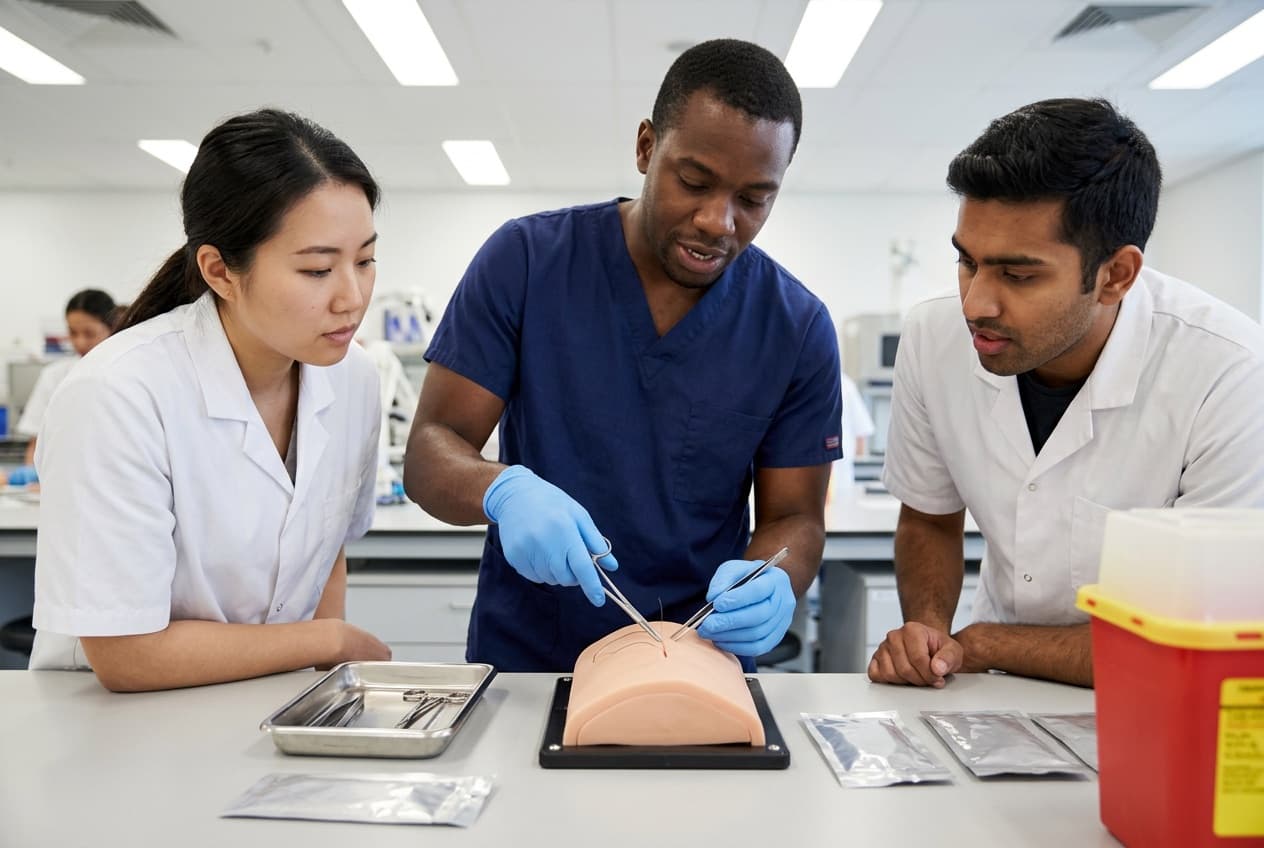
You can know the material cold and still underperform on the day. Interviews are a performance under constraints: a clock, a panel, follow-up questions that arrive before you have finished your last sentence. Surgery already accepts this logic for operating, which is why simulation is embedded in surgical training. The same evidence base has a lot to say about how to prepare for an interview.
What simulation research found
The landmark BEME systematic review by Issenberg and colleagues asked which features of high fidelity simulation actually lead to effective learning, across several decades of studies. The features at the top of the list were not about expensive equipment. They were feedback and repetitive practice, followed by integration into a curriculum, a range of difficulty, and variation in the clinical scenarios practised. A later critical review by McGaghie and colleagues reached similar conclusions, and a large JAMA meta-analysis by Cook and colleagues found that simulation based training was associated with large benefits for knowledge, skills and behaviours compared with no intervention, across hundreds of studies.
Read that list again with an interview in mind. Feedback, repetition, increasing difficulty, scenario variation: none of it is delivered by silently reading a question bank the week before.
Fidelity means the conditions, not the graphics
In simulation, fidelity is how closely practice reproduces the conditions that matter for performance. For an interview, those conditions are specific and reproducible.
| Condition on the day | How to rehearse it |
|---|---|
| Questions arrive by voice, not text | Practise with a question asked aloud, not read silently |
| Answers are spoken and timed | Answer out loud against a visible clock |
| Follow-ups probe your first answer | Use practice that presses further rather than stopping at your first response |
| Performance is scored against criteria | End every run with a mark against the real scale, not a feeling |
Your report
Skin Cancer (Eyelid, Medial Canthus)
Overall
A below average attempt with some correct orientating points but significant gaps in clinical detail, anatomy and management throughout.
You identified the medial canthal location and the pearly, ulcerated appearance, and you correctly flagged high-risk features and the MDT. However, the assessment answer missed the site-specific elements of visual function and lid closure, and the anatomical answer was incorrect. The most important areas to develop are eyelid-specific anatomy, margin-controlled excision for high-risk periocular BCC, and reconstruction scaled to defect size.
The panel marking matrix
Clinical skills and knowledge
You localised the lesion to the medial canthus and named BCC first. However, you omitted the site-specific checks of visual function, lid closure and lacrimal involvement, and your classification did not use the BAD high-risk criteria (H-zone, infiltrative subtype, perineural invasion).
Presentation and communication
Your opening was tentative, with hesitations and answers that trailed off mid-sentence. To improve, commit to a diagnosis at the start, signpost each section, and finish every sentence before moving on.
How would you assess them in clinic?
You said
I would first begin by taking a thorough history from the patient, specifically around the evolution of the lesion, and, uh, the patient’s clinical risk factors. I would then, uh, begin to examine the lesion. I would use an ABCDE approach and would explore this lesion under a dermatoscope.
A stronger version of your answer
I would take a standard skin-cancer history covering the evolution of the lesion and risk factors including sun exposure and immunosuppression. Because this is a periocular lesion, I would also ask about any change in vision, watering or irritation of the eye, and whether the lesion is affecting lid closureEarns the periocular marks: vision, watering and lid closure are the discriminating site-specific points on this mark scheme. or daily activities. On examination I would check the laxity of the surrounding lid tissue with reconstruction in mindShows operative foresight. The panel scores planning for reconstruction, not just recognising the lesion., assess gross visual fields, and arrange an incisional biopsy under local anaesthetic to confirm the diagnosis and subtypeConfirms the diagnosis before management, the safe sequence the mark scheme rewards. before planning further management.
Hover the highlighted phrases to see why each one earns marks.
How would you reconstruct the defect?
You said
For a larger defect I would, uh, take some skin from the cheek as a local flap and use a graft to line the inside of the lid. If I could not close it I would think about staging the repair or referring on.
A stronger version of your answer
For a larger defect I would use a Tenzel semicircular musculocutaneous rotation flapA semicircular musculocutaneous rotation flap for moderate eyelid defects, described by Richard Tenzel in 1975.Tenzel RR, Stewart WB, 1975, which starts at the lateral canthus and curves upward and laterally to recruit anterior lamella, and I would support the posterior lamella with a periosteal flap turned in from the lateral orbital rimPairing an anterior lamella flap with posterior lamella support shows you reconstruct the eyelid as a layered structure.. The Hughes tarsoconjunctival flapA staged tarsoconjunctival flap from the upper lid for posterior lamellar reconstruction of the lower lid, described by Wendell Hughes in 1937.Hughes WL, 1937, the Mustarde cheek rotationA large cheek rotation flap for lower lid and cheek reconstruction, described by John Mustarde in his 1966 work on orbital reconstruction.Mustarde JC, Repair and Reconstruction in the Orbital Region, 1966 and lid-switch flaps are further options for larger defects. Throughout, restoring both lamellae and the lid margin is the priority.
Named techniques are highlighted with who described them, so you can cite them naturally on the day. Interviewers often commend it.
What you did well
You correctly localised the lesion to the medial canthus and described the pearly edge and ulcerated centre.
You flagged a high-risk lesion in a high-risk area requiring MDT discussion, the correct governance instinct.
Focus areas
Eyelid anatomy is the most urgent gap: a full-thickness lesion needs excision through both lamellae, reconstructed layer by layer.
Where Mohs is unavailable, state a 5 mm margin, send an oriented specimen and stage reconstruction until clearance is confirmed.
What to vary between runs
Two of the BEME features are easy to miss: a range of difficulty and clinical variation. A candidate who reruns the same three comfortable stations is rehearsing comfort, not capability. Between mocks, rotate the station types you find hardest, let the follow-up questions get more awkward, and bring in scenarios you have never seen, because the real panel will. Familiarity with the format is also worth something in itself: the first time a timer runs out mid-sentence should not be on the day that counts.
- 1Weeks out: a baseline mockSit one full, timed mock early. The point is not the score, it is the report: it tells you where the next weeks of practice should go.
- 2Between mocks: short feedback cyclesRun single scenarios aloud, get each one marked, and rerun your weakest station types at increasing difficulty.
- 3The final week: one dress rehearsalA last full mock under exact conditions, then review its report line by line rather than cramming new material.
Repetition with feedback, not repetition alone
The simulation literature is blunt that repetition by itself is not enough: the learning comes from cycles of attempt, feedback and corrected re-attempt. That matches the deliberate practice tradition described by Ericsson, where experts improve through focused repetitions that target specific weaknesses rather than replaying comfortable material. For interviews, that means treating each mock's report as the plan for the next fortnight of practice: rerun the stations you scored lowest on, not the ones you enjoy.
How TheatrePass helps
TheatrePass Timed Mock Interviews reproduce the conditions above: a full interview against the clock with a live interviewer voice, timed sections, authored follow-ups, and a marked report at the end scored on the official 0 to 5 interview scale, section by section. Between mocks, the Virtual Tutor gives the shorter feedback and repetition cycles the evidence favours, one scenario at a time.
References
- Issenberg SB, McGaghie WC, Petrusa ER, Lee Gordon D, Scalese RJ. Features and uses of high-fidelity medical simulations that lead to effective learning: a BEME systematic review. Medical Teacher, 2005.
- McGaghie WC, Issenberg SB, Petrusa ER, Scalese RJ. A critical review of simulation-based medical education research: 2003 to 2009. Medical Education, 2010.
- Cook DA, Hatala R, Brydges R, et al. Technology-enhanced simulation for health professions education: a systematic review and meta-analysis. JAMA, 2011.
- Ericsson KA, Krampe RT, Tesch-Romer C. The role of deliberate practice in the acquisition of expert performance. Psychological Review, 1993.
Interview formats and selection criteria change between recruitment cycles. Content is reviewed each cycle and dated; always confirm details against the current national recruitment guidance.