Portfolio & Strategy
Retrieval Practice and Multimedia Learning in Interview Preparation
Why answering questions out loud beats re-reading model answers, and why images change what you remember: the evidence, applied to surgical interviews.
By the TheatrePass editorial team · updated 1 September 2026 · 4 min read
Most candidates prepare for a spoken interview by reading. You work through a question bank at night, read the model answer, nod, and move on. It feels productive, and it is genuinely useful for coverage. The problem is that the interview itself is not a reading task: it is timed retrieval, out loud, under pressure, often with a photograph in front of you. This guide sets out what learning research says about that gap, and how to close it.
What the testing effect shows
In a well known series of experiments, Roediger and Karpicke had students either repeatedly study prose passages or repeatedly recall them from memory, then tested everyone later. On an immediate test, the re-readers did better. On the delayed tests, days to a week later, the pattern reversed: the students who had practised retrieving the material retained substantially more than those who had only re-read it. The act of pulling an answer out of your own head strengthens memory in a way that re-exposure does not.
This is not one isolated finding. A major review by Dunlosky and colleagues rated practice testing as one of the two most effective study techniques across the whole education literature, ahead of highlighting, summarising and re-reading, the techniques most students actually use.
Practise in the format of the day
There is a second, related principle: memory works best when the conditions of practice match the conditions of performance, described in the classic literature as transfer appropriate processing. An interview asks you to produce structured, spoken answers to a question you have just heard, then defend them against follow-ups. Recognising a correct answer on a page and producing one aloud are different skills. If the day is spoken, a meaningful share of your preparation has to be spoken too.
Why images belong in your preparation
Multimedia learning research, led by Richard Mayer, has repeatedly found that people learn better from words and pictures together than from words alone, and dual coding theory offers the mechanism: verbal and visual material are stored along separate, complementary channels. Clinical interviews lean on this directly. Many stations open with a photograph or a radiograph, and the first marks are often for describing what you see before you commit to a plan. That is a skill you can only rehearse with the image in front of you.
Interview Library › Clinical Scenario › Skin Cancer (Forearm)
Clinical Scenario
Skin Cancer (Forearm)
A 32-year-old woman attends clinic worried about a changing mole on her forearm. You are shown a photograph. How would you approach her?
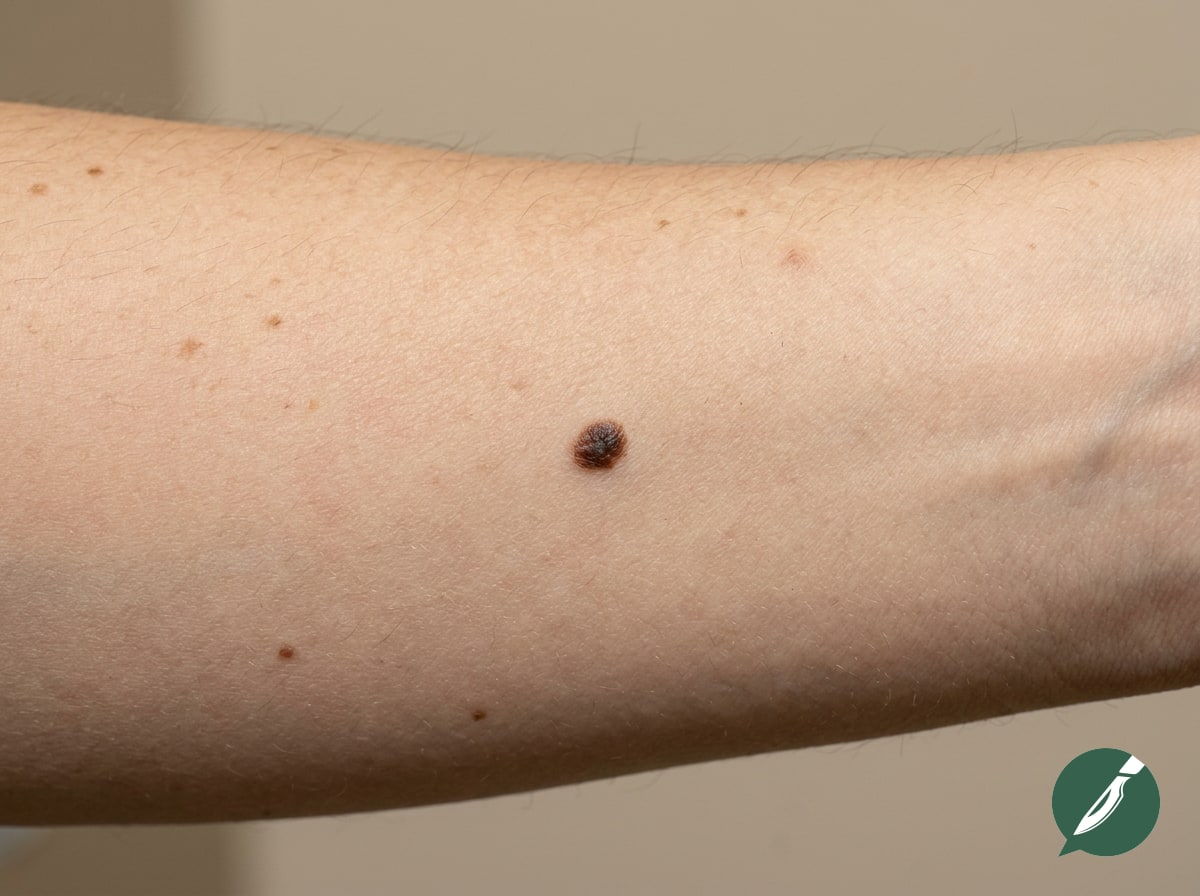 Clinical imagesA real clinical photograph, exactly as it is shown on the interview day.
“"This is a clinical photograph of the forearm, and there is a pigmented lesion around 4 millimetres across. It looks fairly symmetrical with a slightly darker centre, but because she reports it is changing my job is to exclude a melanoma. My differentials would be a benign compound or junctional naevus, a Spitz naevus, and a pigmented basal cell carcinoma.”
“I would take a focused history using the changing-lesion features: any change in size, shape or colour, bleeding, itching or a new lesion. About risk: a fair skin type and easy burning, sun exposure and severe sunburns, time abroad, immunosuppression, a large number of atypical moles, and a personal or family history of melanoma. Then the usual medical history.”
Why this scores
“because she reports it is changing my job is to exclude a melanoma”
the history of change drives the whole approach.
“a full-thickness excision biopsy taken with a cuff of fat and a 2 millimetre margin as per NICE, rather than…”
the correct, specific biopsy for a suspected melanoma, named to the guideline.
References
Revised U.K. guidelines for the management of cutaneous melanoma 2010 British Association of Dermatologists, British Journal of Dermatology
Clinical Scenario · 61 scenarios
10 more…
How to apply this
- 1Attempt before you readRead the question, look at the image, and say your answer aloud before you open the model answer. The model answer then becomes feedback on a real attempt rather than a script to recognise.
- 2Describe the image firstWhen a question carries a photograph, practise the describe-then-plan habit every time: what you see, in plain clinical language, then what you would do.
- 3Space your returnsCome back to the same scenario days later and retrieve it again. Spaced retrieval is where the retention gains compound.
- 4Close the loop with markingRetrieval practice works best when you find out what your attempt missed. Get your spoken answer scored against the criteria, not just compared by feel.
Spoken practice
Skin Cancer (Forearm)
 George is asking your follow-upBritish, warm · speaks, listens, then presses furtherThe interviewerA real interviewer voice asks and follows up. The waveform moves while the tutor speaks; here it is drawn still.
“The pathology shows a Breslow thicknessThe vertical tumour thickness of melanoma, the strongest prognostic factor, described by Alexander Breslow in 1970.Breslow A, Ann Surg 1970 of 1.4mm with a normal mitotic rate and no ulceration, and there are no palpable nodes. What next?”
“"By the AJCC 8th edition a 1.4 millimetre non-ulcerated melanoma is a pT2a, so clinical stage IB. In line with NICE the plan is a wide local excision and to offer a sentinel lymph node biopsy. For a tumour in this thickness band the excision margin is 1 centimetre, taken down to the deep muscle fascia and oriented for the pathologist.”
Marked in moments
Good (4 of 5)“By the AJCC 8th edition a 1.4 millimetre non-ulcerated melanoma is a pT2a, so clinical stage IB”
correct staging, named to the system once.
Where reading still fits
None of this makes reading worthless. Reading is how you build coverage in the first place: the frameworks, the guidelines, the model answers you will later be marked against. The evidence is about proportion and order. Early in preparation, reading dominates because there is not much to retrieve yet. As the interview approaches, the balance should swing hard towards spoken retrieval, with reading demoted to filling the specific gaps your attempts expose. If the week before your interview looks the same as the month before it, the proportion is wrong.
How TheatrePass helps
TheatrePass is built around spoken retrieval rather than reading. Every scenario in the Interview Library can be attempted aloud with the Virtual Tutor, which asks the question, listens, presses with follow-ups and marks the answer against the official 0 to 5 interview scale, and questions carry their clinical images so you rehearse describing what you see. The model answer and its marking notes are there when you want them, positioned after the attempt, not instead of it.
References
- Roediger HL, Karpicke JD. Test-enhanced learning: taking memory tests improves long-term retention. Psychological Science, 2006.
- Dunlosky J, Rawson KA, Marsh EJ, Nathan MJ, Willingham DT. Improving students' learning with effective learning techniques. Psychological Science in the Public Interest, 2013.
- Morris CD, Bransford JD, Franks JJ. Levels of processing versus transfer appropriate processing. Journal of Verbal Learning and Verbal Behavior, 1977.
- Mayer RE. Multimedia Learning, second edition. Cambridge University Press, 2009.
- Paivio A. Mental Representations: A Dual Coding Approach. Oxford University Press, 1986.
Interview formats and selection criteria change between recruitment cycles. Content is reviewed each cycle and dated; always confirm details against the current national recruitment guidance.