ST3 Specialties
Trauma and Orthopaedic Surgery ST3 Interview Guide 2026
How T&O ST3 selection works: trauma call scenarios, honest operative numbers talk, audit that survives probing and composure under follow-up questions.
By the TheatrePass editorial team · updated 1 September 2026 · 4 min read

Trauma & Orthopaedics has been one of the most heavily applied-to ST3 fields in recent cycles, and its interview carries a matching reputation: panels that probe, follow-up questions that keep coming, and candidates with strong portfolios who still leave the room unsure what happened. The useful truth is that the interview rewards exactly the things that can be rehearsed: structure, safe trauma patterns, honest logbook talk and composure under pressure. This guide covers how selection works, the trauma scenarios at pattern level, how to talk about operative numbers, what audit evidence is expected to look like, and a technique for staying steady while being probed.
How T&O selection works
Recruitment is nationally coordinated through Oriel: a self-assessment scored against a published system, verification of your evidence, and a structured interview. The validated self-assessment shortlists you, and its weighted score then counts again in your final rank alongside the interview. The interview itself is a 60-minute online panel of four 10-minute stations, each preceded by 5 minutes of reading time: a clinical judgement scenario, a prioritisation exercise, a patient communication scenario, and a commitment to specialty conversation, each scored on five set domains by two interviewers working independently. The panel in the commitment station cannot see your portfolio, so your evidence lives in what you say. Verification matters more than most people expect: a downgraded claim costs points twice, once in the score and again when the panel asks about it.
The trauma call
Scenario stems are written to test judgement, not operative technique. Four families recur:
- The open lower limb fracture: haemorrhage control, realignment and splintage, antibiotics according to local policy, appropriate wound handling, and early combined planning with plastic surgery. Showing that you know national standards shape this pathway is itself worth marks.
- The swollen, disproportionately painful limb: compartment syndrome is a clinical diagnosis. Say the recognition features, the immediate bedside actions and the urgency of senior involvement and theatre, without hedging.
- The frail patient with a hip fracture: pathway thinking scores here: early optimisation, orthogeriatric involvement, prompt surgery and an awareness that this care is measured against national audit.
- The polytrauma call: a systematic, team-based approach along current trauma life support principles, clarity about your own role in the team, and explicit escalation.
In every family the marks sit in the same places: structured assessment, safe immediate actions, a named escalation, and awareness of the standards that define good care. If you finish an answer without having said who you called and when, you have left marks on the table.
Talking about operative numbers
Panels read logbooks for a living, so this conversation rewards honesty and insight more than totals. Know your consolidated numbers and supervision codes from memory, and choose a small set of index cases before the day. Be ready to discuss one the way a surgeon discusses a case: the decision to operate, the consent conversation, the steps in outline, what was difficult, and what you would do differently now. Never inflate a supervision level. One precise follow-up question exposes it, and the doubt spreads to everything else you have claimed.
Audit that survives probing
One completed loop beats three abandoned ones. The convincing shape is a standard worth auditing against (national trauma standards and guidance offer plenty), a first cycle you genuinely led, a change that was actually implemented, and a re-audit showing movement. Expect the probes: what changed, what resistance you met, whether the improvement persisted, and what you would do next. If the loop is honest, these questions are easy. If it is decorated, they are not.
Composure under probing
Probing is the house style in this interview. It is not hostility; it is how panels find the edge of your judgement. A repeatable technique:
- 1Take the breathA one-second pause before a hard follow-up reads as composure, not weakness. Use it to choose a structure instead of reacting to the pressure.
- 2Restate the principleAnchor the answer to patient safety or to your framework. It gives the reply a spine and buys thinking time honestly.
- 3Commit safelyGive a decision with reasoning. A clear, safe plan with explicit escalation scores; an answer hedged in every direction does not.
- 4Know your stop lineWhen a question moves past your experience, say what you would do and who you would involve. "At that point I would want my consultant present" is a scoring answer, not a surrender.
Common pitfalls
- Reciting classification systems instead of describing safe management.
- Quoting logbook totals you cannot back up with a fluent case discussion.
- An audit story in which the change cannot be evidenced.
- Treating the first follow-up question as a sign the answer has failed.
- Preparing silently and meeting spoken probing for the first time on the day.
The plan
Eight weeks out, work a question bank and consolidate the logbook. From six weeks, answer aloud daily: trauma scenarios, management structures and portfolio one-liners, all timed. In the final fortnight, run full mock circuits with deliberate interruptions, and rehearse your chosen index cases aloud until you can discuss them fluently from any angle the panel picks.
Interview format and key dates
4
Stations of 10 minutes, each after 5 minutes of reading
37
Maximum points in the published 2027 self-assessment
2
Independent interviewers scoring every station
5
Domains scored per station, published in the handbook
| Stage | Date (2026 cycle) |
|---|---|
| Applications open | 20 November 2025 |
| Applications close | 16 December 2025 |
| Self-assessment validation | 27 to 28 January 2026 |
| Interviews | 24 to 27 March 2026 |
| Initial offers | by 14 April 2026 |
Interview Library › Clinical Judgement › Hip Osteoarthritis and Elective Total Hip Replacement
Clinical Judgement
Hip Osteoarthritis and Elective Total Hip Replacement
A patient in their late 60s is referred to your elective orthopaedic clinic with around two years of progressive right groin pain. The pain is worse on weight-bearing and at the end of the day, there is stiffness for the first few minutes after getting up, and their walking distance has fallen from a couple of miles to a few hundred…
You are shown a weight-bearing AP pelvis radiograph. How would you assess this patient in clinic?
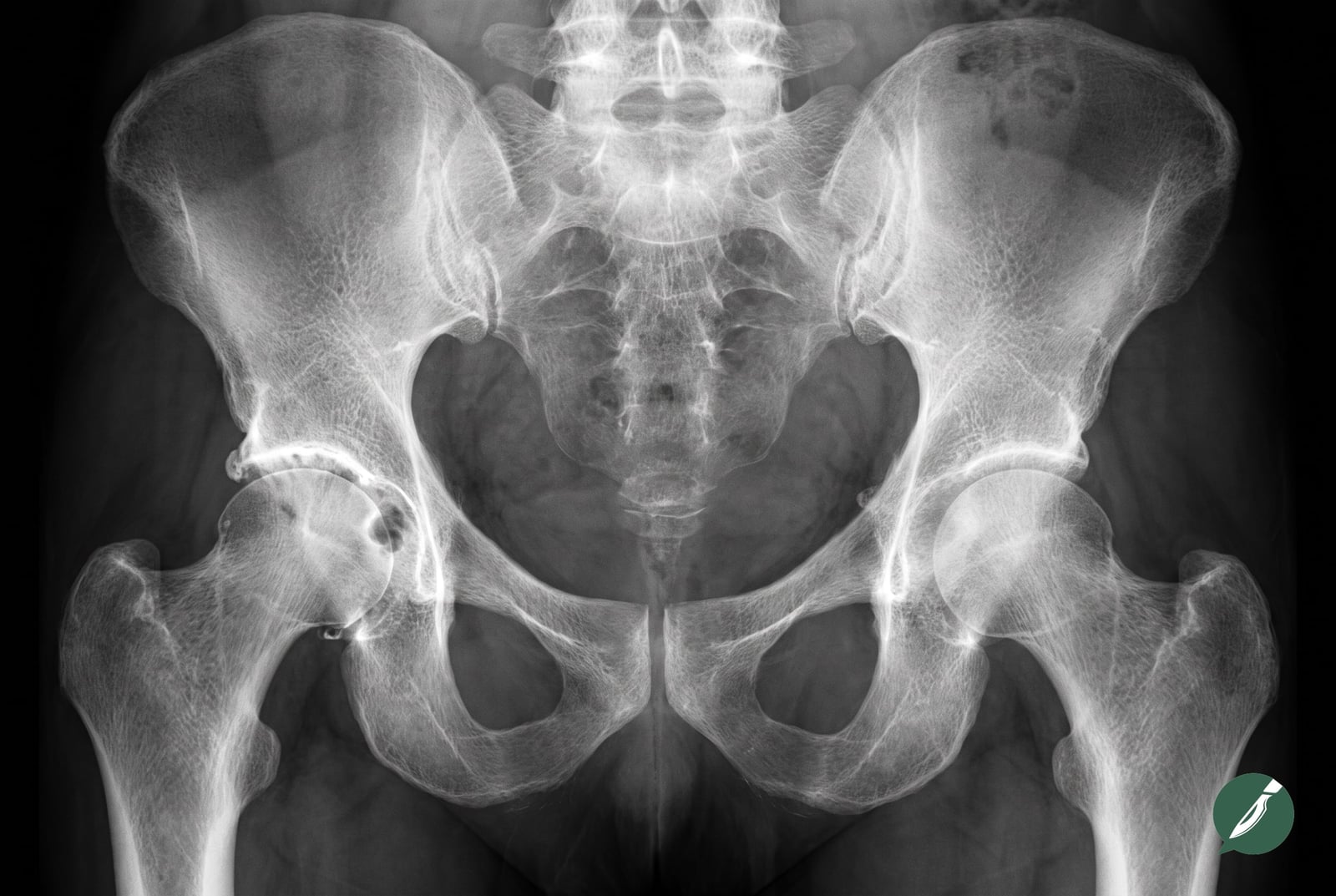 Clinical imagesA real clinical photograph, exactly as it is shown on the interview day.
“"From the radiograph there is osteoarthritis of the right hip, with the four classic features: joint-space narrowing, osteophytes, subchondral sclerosis and subchondral cysts. The history of activity-related groin pain, start-up stiffness and a falling walking distance fits an osteoarthritic hip, so my clinic assessment is about confirming that, judging its impact, and deciding whether this has become a surgical…”
“I would take a focused history first: the site and character of the pain, that classic groin pain radiating to the knee, the start-up stiffness, night pain, and above all the functional impact, so their walking distance, stairs, putting on socks and shoes, sleep and work, and what they can no longer do that matters to them. I would ask what conservative measures have been tried and how well, and screen their general…”
Why this scores
“there is osteoarthritis of the right hip, with the four classic features: joint-space narrowing, osteophytes,…”
describes the film first and names the four features precisely.
“above all the functional impact, so their walking distance, stairs, putting on socks and shoes, sleep and…”
centres the assessment on function and the patient rather than the image.
References
Osteoarthritis in over 16s: diagnosis and management (NG226) NICE
Clinical Judgement · 78 scenarios
5 more…
How TheatrePass helps
TheatrePass pairs a Trauma & Orthopaedics ST3 question bank (surgeon-written scenarios, model answers and frameworks) with mock interviews that push follow-up questions the way a panel does, then give structured feedback on structure, safety language and timing. It exists so that the first time you are probed aloud is not interview day.
Interview formats and selection criteria change between recruitment cycles. Content is reviewed each cycle and dated; always confirm details against the current national recruitment guidance.