ST3 Specialties
Plastic Surgery ST3 Interview Guide 2026
Preparing for Plastic Surgery ST3: depth-first questioning, acute plastics scenarios at pattern level, commitment evidence and layered follow-ups.
By the TheatrePass editorial team · updated 1 September 2026 · 4 min read
Plastic surgery runs one of the smaller ST3 intakes in surgery, and it shows in the interview room: a short list of posts, a long list of credible applicants, and panels that can afford to go deep on every one of them. Breadth gets you longlisted. Depth gets you appointed. This guide covers what depth-first questioning feels like, the acute plastics scenarios at pattern level, the commitment evidence that reads as real, what the portfolio still needs across the board, and a technique for follow-up questions that arrive in layers.
How selection tends to run
Plastics recruitment runs as a national selection process through Oriel, with a verified self-assessment and an interview of three ten minute stations that you rotate between in any order: OSCE Communication, a clinical scenario and a structured interview. Five minutes of reading comes before the OSCE and before nothing else, timed at 2.5 minutes for each of its two scenarios. The weighting has been stable across cycles: the OSCE 30 per cent, the clinical scenario 25, the structured interview 25 and the verified self-assessment 20, with every section scored 0 to 5. The applicant guidance and person specification for your year are still the documents to plan against, and they are worth reading before anything else in this guide.
An interview that tests depth
Most interviews sample widely. Plastics panels tend to pick an item and descend. A typical chain: tell me about this publication; what exactly was your contribution; why that method; what would you change now; how has it changed your practice. Five questions, one line of your CV. Two layers of preparation is not enough. For every line in your portfolio, prepare three: the fact, the significance, and the honest reflection or next step. If you cannot speak to the third layer, assume the panel will discover that in front of you.
Common acute plastics scenarios
Clinical stems stay at registrar-judgement level: recognition, immediate safe actions and escalation. The recurring families:
- The flap that looks different: a ward call about a free flap with a colour change is time-critical. The marks are in urgency: immediate bedside review, a structured assessment of the flap, and senior escalation without delay, because decisions about returning to theatre sit with the consultant.
- The burns referral: a structured assessment, an accurate description of extent and depth at pattern level, resuscitation begun according to current guidance, and early referral against the national network criteria.
- The injured hand: systematic examination, recognition of the structures at risk, and a safe plan: analgesia, splintage, antibiotics where local policy indicates, and the right operating list at the right speed.
- The spreading soft tissue infection: name the worry and convey the urgency. Clinical suspicion of necrotising infection is an immediate senior conversation and a theatre conversation, not a watch-and-wait plan.
Notice what is absent: operative detail. Panels are not asking you to operate. They are checking that you are safe, structured, and honest about where your decision-making ends and your consultant's begins.
Commitment evidence that reads as real
Because the field is small, commitment is probed hard. What convinces is a timeline, not a cluster: taster weeks and theatre exposure sought out early, a plastics-relevant audit or quality improvement project, regional meeting attendance, relevant courses, and academic output that accumulated over a couple of years. A burst of activity in the three months before the application window reads as exactly that. If your trail is short, be honest about when the decision crystallised and show what you have done since. Panels respect a true story told plainly more than a decorated one.
Portfolio breadth still matters
Depth questioning does not remove the need for a complete portfolio. The recurring expectations:
| Domain | What panels look for |
|---|---|
| Logbook | Honest breadth across trauma and elective exposure, with supervision levels you can defend in conversation. |
| Audit and QI | A closed loop on a plastics-relevant question, with a change you can describe and evidence. |
| Academia | Output where you can state your exact contribution and answer a methods question without flinching. |
| Teaching | A sustained commitment with collected feedback, ideally including practical skills teaching. |
| Commitment | The multi-year trail described above, documented and verifiable. |
Handling multi-level follow-ups
- 1Answer cleanly, then stopGive the structured answer and let the panel choose the next layer. Filling the silence invites questions you did not need to face.
- 2Expect the ladder"And if that does not work?" is coming. Escalate within the scenario: the next safe step, the next senior, the next setting. Never invent detail to appear complete.
- 3Hold the spineEach deeper answer keeps the same shape: assess, act safely, escalate. Depth changes the content, not the structure.
- 4Own the boundaryWhen the ladder passes your level, say so with confidence: what you would prepare, and the conversation you would have with your consultant. That judgement is the thing being hired.
Common pitfalls
- Treating commitment questions as a formality and answering with generalities about the specialty.
- A portfolio one layer deep: the fact without the significance or the reflection.
- Inventing microsurgical detail under pressure instead of escalating within the scenario.
- Underplaying breadth: depth questioning still sits on top of a complete portfolio.
- Practising silently, then meeting a five-question ladder aloud for the first time at interview.
The plan
Work a question bank early, but spend most of your hours speaking: daily timed answers across the acute families, portfolio items rehearsed to three layers, and commitment questions answered aloud without notes. Once a week, run a timed circuit in which someone, or something, keeps asking the follow-up.
Key dates for 2026
| Stage | Date |
|---|---|
| Applications open | 20 November 2025 |
| Applications close | 11 December 2025 |
| Evidence upload window | 18 December 2025 to 5 January 2026 |
| Self-assessment verification | 13 to 14 January 2026 |
| Interview window | 10 to 11 February 2026 |
| Initial offers | by 14 April 2026 |
Interview Library › Clinical Scenario › Skin Cancer (Forearm)
Clinical Scenario
Skin Cancer (Forearm)
A 32-year-old woman attends clinic worried about a changing mole on her forearm. You are shown a photograph. How would you approach her?
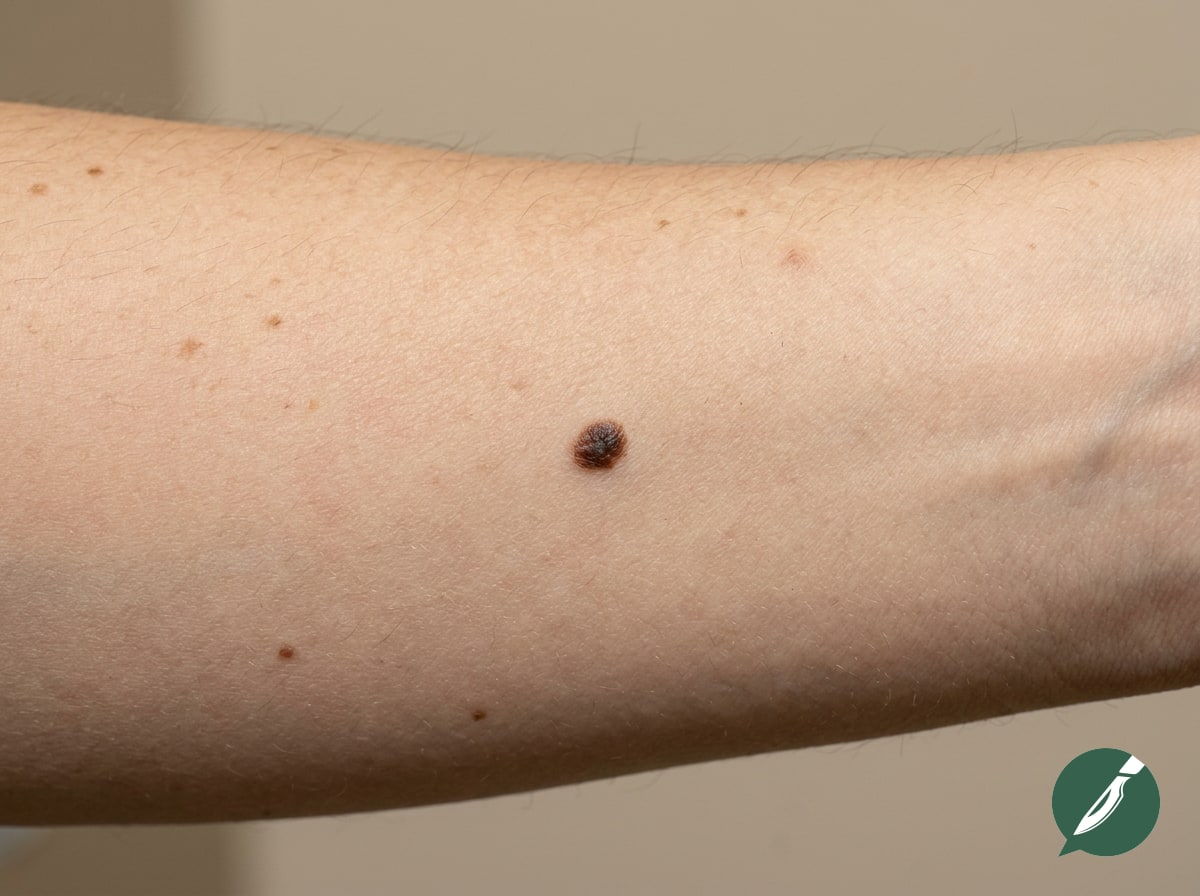 Clinical imagesA real clinical photograph, exactly as it is shown on the interview day.
“"This is a clinical photograph of the forearm, and there is a pigmented lesion around 4 millimetres across. It looks fairly symmetrical with a slightly darker centre, but because she reports it is changing my job is to exclude a melanoma. My differentials would be a benign compound or junctional naevus, a Spitz naevus, and a pigmented basal cell carcinoma.”
“I would take a focused history using the changing-lesion features: any change in size, shape or colour, bleeding, itching or a new lesion. About risk: a fair skin type and easy burning, sun exposure and severe sunburns, time abroad, immunosuppression, a large number of atypical moles, and a personal or family history of melanoma. Then the usual medical history.”
Why this scores
“because she reports it is changing my job is to exclude a melanoma”
the history of change drives the whole approach.
“a full-thickness excision biopsy taken with a cuff of fat and a 2 millimetre margin as per NICE, rather than…”
the correct, specific biopsy for a suspected melanoma, named to the guideline.
References
Revised U.K. guidelines for the management of cutaneous melanoma 2010 British Association of Dermatologists, British Journal of Dermatology
Clinical Scenario · 61 scenarios
10 more…
How TheatrePass helps
TheatrePass includes a plastic surgery ST3 bank of surgeon-written scenarios, model answers and frameworks, and mock interviews that ask the follow-up, then the follow-up to the follow-up, with structured feedback on content, safety language and delivery. Depth-first interviews reward exactly that kind of rehearsal.
Interview formats and selection criteria change between recruitment cycles. Content is reviewed each cycle and dated; always confirm details against the current national recruitment guidance.